How AI-Powered Software is Transforming Manufacturing Operations in Nigeria
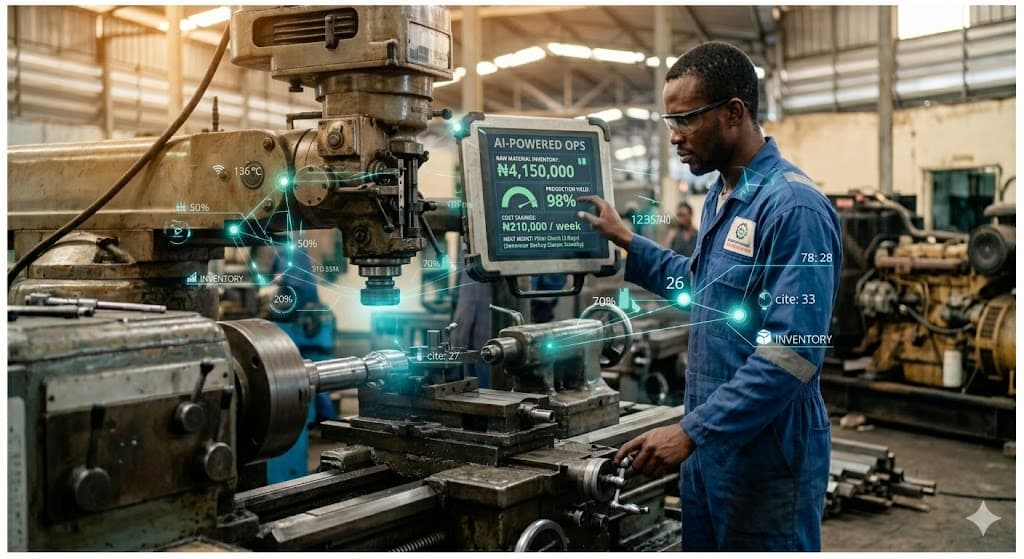
How AI-Powered Software is Transforming Manufacturing Operations in Nigeria
Nigeria is Africa's largest economy, yet its manufacturing sector has long struggled with inefficiency, manual processes, and outdated operational systems. For decades, factory owners and industrial operators across Lagos, Kano, Port Harcourt, and Abuja have relied on paper-based records, disconnected spreadsheets, and guesswork—tools that simply cannot keep pace with the demands of a modern, competitive market.
That is changing. Rapidly.
Artificial intelligence and next-generation software platforms are no longer the exclusive domain of Silicon Valley giants or Fortune 500 companies. Today, Nigerian manufacturers—from mid-sized producers to large-scale industrial operations—are leveraging AI-powered tools to reduce costs, improve quality control, and make smarter decisions faster. At AIXILCOILS NEXTGENSOFT, we are at the forefront of this transformation, building solutions specifically designed for the Nigerian and broader African industrial landscape.
The problem with how Nigerian manufacturers have operated
To understand why AI-powered software matters so much right now, you first need to understand the scale of the inefficiency problem. A 2025 survey by the Manufacturers Association of Nigeria (MAN) found that over 65% of small and medium-scale manufacturers still rely primarily on manual processes for production tracking, inventory management, and quality control. The consequences of this are severe:
- Production bottlenecks caused by poor scheduling and resource allocation
- Inventory losses due to overstocking, spoilage, or untracked raw materials
- Quality failures that result in product recalls and reputational damage
- Inability to forecast demand accurately, leading to costly overproduction or supply shortfalls
- Compliance and reporting delays that cost time and money
These are not small inconveniences. They represent billions of naira in lost value every year—and they compound over time. The manufacturer that cannot control its processes today will not survive the competition of tomorrow.
What AI-powered software actually does on the factory floor
When people hear "artificial intelligence in manufacturing," they often picture robots replacing workers. The reality in the Nigerian context is far more practical—and far more immediately valuable. AI-powered software works as an intelligent layer on top of your existing operations, making sense of data you already have and turning it into actionable decisions.
Here is what that looks like in practice:
1. Predictive maintenance
Instead of waiting for a machine to break down—which can halt production for days and cost hundreds of thousands of naira in repairs—AI-powered systems monitor equipment performance in real time and flag early warning signs before failure occurs. Companies using predictive maintenance typically reduce unplanned downtime by 30–50%.
2. Intelligent inventory management
AI systems can analyse historical purchase patterns, current stock levels, supplier lead times, and market conditions to automatically generate optimal reorder points. For a manufacturer dealing with fluctuating raw material prices—a very common reality in Nigeria—this kind of intelligence is worth its weight in gold.
3. Quality control automation
Computer vision and machine learning models can inspect products on the production line far faster and more accurately than human inspectors, catching defects that would otherwise slip through and reach the customer. This protects your brand reputation and reduces costly returns.
4. Demand forecasting
By analysing sales data, seasonality trends, economic indicators, and even external factors like public holidays and fuel price changes, AI platforms can produce remarkably accurate demand forecasts. This allows manufacturers to plan production schedules weeks or months in advance—reducing waste and maximising throughput.
Why local software matters more than imported solutions
One of the most persistent challenges Nigerian manufacturers have faced when adopting technology is that most enterprise software platforms were designed for Western markets. They are expensive, they assume infrastructure—stable power, fast broadband, large IT teams—that does not always exist in Nigeria, and they do not account for the nuances of the Nigerian operating environment.
This is where AIXILCOILS NEXTGENSOFT is fundamentally different. Our software is built from the ground up for Nigerian and African industrial businesses. That means it is designed to work reliably in low-bandwidth environments, it is priced for the local market, it supports naira-denominated accounting and Nigerian tax compliance, and—critically—our support team speaks your language and understands your specific challenges.
We are not selling you a one-size-fits-all product from a server farm in California. We are building with you, for you, in Nigeria.
The business case: what the numbers say
Scepticism is healthy, and we encourage every business owner to ask hard questions before adopting any new technology. So let us look at what the data actually says about AI adoption in manufacturing.
According to a McKinsey Global Institute report on AI in manufacturing, companies that fully implement AI-driven processes see:
- Up to 20% reduction in production costs
- 15–35% improvement in equipment uptime
- 10–20% increase in overall yield and throughput
- Significant reduction in quality defects and rework costs
For a Nigerian manufacturer with an annual turnover of ₦500 million, a 20% reduction in production costs alone represents ₦100 million in savings. The ROI on quality software pays for itself—often within the first year.
Getting started: what the adoption journey looks like
The most common barrier to adopting new software is not cost—it is fear of disruption. Business owners worry that implementing a new system will slow down operations, confuse staff, and cause more problems than it solves.
That concern is valid, and it is exactly why implementation methodology matters as much as the software itself. At AIXILCOILS NEXTGENSOFT, our onboarding process is designed to minimise disruption:
- We start with a thorough operational audit to understand your current processes and pain points
- We implement in phases, starting with the highest-impact areas first
- We train your team thoroughly before going live
- We provide hands-on support during the transition period
- We monitor performance closely and iterate based on real-world feedback
The goal is not to replace how you work—it is to make how you work dramatically more effective.
The window of opportunity is open—but not forever
Nigeria's manufacturing sector is on the cusp of a genuine technological leap. The businesses that move early—that invest in intelligent software now—will build operational advantages that are very difficult for late movers to overcome. They will produce more efficiently, at lower cost, with higher quality, and with greater visibility into their operations than their competitors.
The question is not whether AI-powered software will transform Nigerian manufacturing. It will. The question is whether your business will be one of the early adopters shaping that transformation—or one of the laggards scrambling to catch up.
At AIXILCOILS NEXTGENSOFT, we are ready to help you move first.
Ready to see what next-gen software can do for your operations?
Visit aixilcoils.com.ng or contact our team for a free consultation and operational assessment.